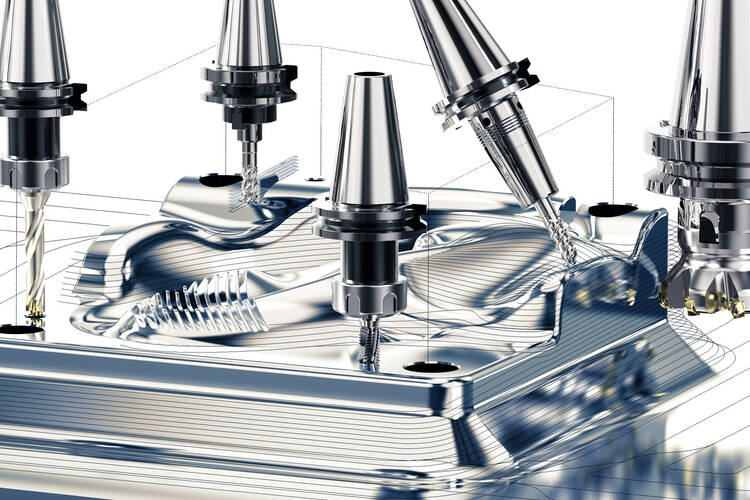
Detailed components often require more than cutting, bending, and joining basic material shapes. A custom machine shop produces parts to exact digital specifications, while standard fabrication usually focuses on larger structures made from sheet, plate, tubing, or structural sections. Understanding the difference helps manufacturers choose the right process for prototypes, automation equipment, replacement parts, and specialized production assemblies.
1. Precision Machining Creates Detailed Features
Standard fabrication commonly uses welding, forming, sawing, punching, and plasma or laser cutting to build frames, enclosures, platforms, and other structural items. Those methods work well when the job depends on general dimensions rather than extremely close fits.
CNC machining takes a different approach by removing material through programmed tool movements. Mills and lathes can create bearing bores, threaded holes, pockets, grooves, curved surfaces, and precise mounting locations. Professional machining services also control the relationship between separate features, which matters when a component must align with shafts, sensors, gears, or robotic joints.
2. Precision That Keeps Parts Aligned and Moving as Designed
Fabricated assemblies can allow slight variation when parts will be welded, bolted, or adjusted during installation. Machined components often need far narrower limits because small dimensional errors may cause binding, vibration, leakage, or uneven wear.
Precision machining companies use calibrated equipment and planned inspection methods to keep measurements within the specified range. Coordinate measuring machines, micrometers, bore gauges, and optical systems verify different features throughout production. Buyers searching for CNC machining near me should ask how a provider checks tolerances instead of assuming the machine alone guarantees accuracy.
Common tolerance-sensitive features include:
- Bearing and bushing seats
- Locating holes and dowel positions
- Sealing faces and fluid passages
- Mating surfaces between assemblies
- Shafts, threads, and internal diameters
3. Digital Programming Makes Complex Geometry Repeatable
Fabricators often work from drawings, templates, and physical measurements, especially for one-off structures. A custom machine shop usually relies on CAD models and CAM programs to define exactly how cutting tools approach the workpiece.
Programmed CNC services can reproduce complex geometry across several parts without manually laying out each feature. Multi-axis equipment may also reach angled faces or several sides during one setup, reducing repositioning errors. Manufacturers comparing CNC services near me should review the shop’s axis capability, work envelope, and software compatibility before assigning a difficult component.
4. Specialized Fixtures Protect Unusual Parts
Standard clamps and welding tables can support many fabrication projects because the materials often have flat or straight surfaces. Irregular machined parts may need dedicated workholding that locates each blank accurately without blocking the cutting tool.
Custom fixtures, soft jaws, locating pins, and support plates keep the workpiece stable as material is removed. Careful fixture design prevents thin walls from bending and limits vibration around deep pockets or narrow sections. Experienced machining companies also document these setups so future batches can match the approved production method.
Useful workholding decisions consider:
- Where clamping force can be applied safely
- Which surfaces establish the part location
- How the tool will reach each feature
- Whether the material may distort during cutting
- How quickly operators can load repeat pieces
5. Material Behavior Shapes the Cutting Process
Fabrication processes often focus on whether a material can be formed, welded, or cut into a basic shape. Machining requires a deeper look at hardness, heat transfer, chip formation, internal stress, and tool wear.
Aluminum may cut quickly but stick to an edge, while stainless steel can harden if the cutter rubs. Titanium traps heat near the tool, and engineering plastics may move or melt without proper support. Skilled machining services near me should adjust feed rates, coolant, tooling, and cutting depth to suit the selected grade rather than applying one method to every material.
6. Custom Shops Support Prototypes and Controlled Production
Standard fabrication works well for structural builds, repairs, guards, bases, and welded assemblies. Custom machining becomes more useful when a project involves a new part, a discontinued component, a short production run, or a design that may change after testing.
Prototype work gives engineers a physical component to measure, assemble, and evaluate before approving larger quantities. Stored programs, fixture records, and inspection plans then make later orders easier to repeat. Companies reviewing machining companies near me benefit from providers that can move from one trial part into low- or higher-volume production without losing revision control.
Amtec Solutions Group can support projects that require more than standard fabrication by combining CNC machining, custom part production, inspection, and automated manufacturing knowledge. Its capabilities suit manufacturers that need accurate prototypes, robotic components, replacement parts, specialized fixtures, and repeat production handled through one coordinated resource.